


We’re upgrading our hospital and working to keep disruption to a minimum. Learn more.
Shoulder Injuries in Racquet Sports
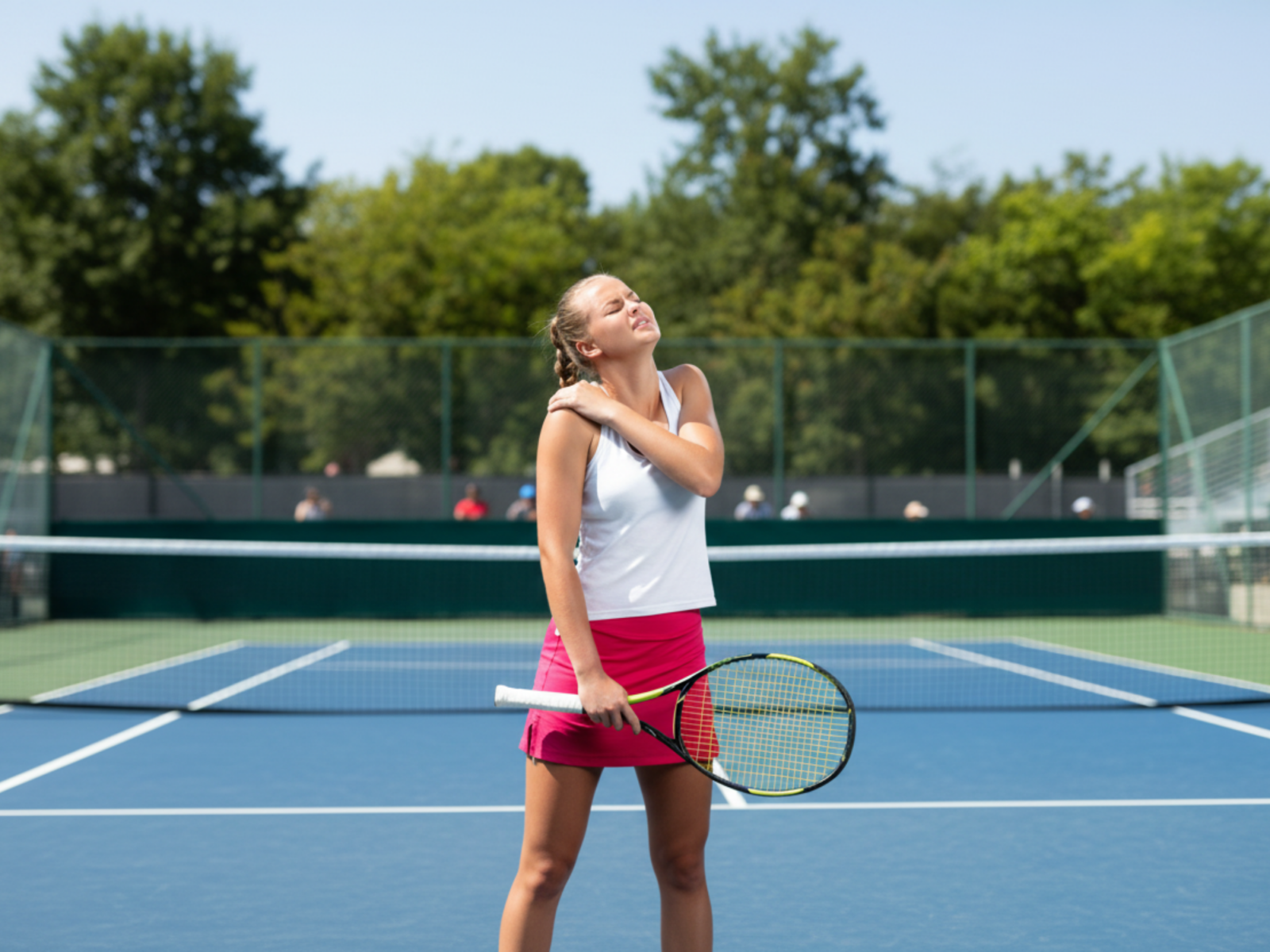
When playing racquet sports, the shoulder joint is most at risk of injury and amateur players tend to have no idea how much strain they are putting it under. Here is what every tennis, padel and squash player needs to know, what to watch out for and when to get that niggling injury seen.
Every summer, courts fill up. Tennis clubs see their biggest membership spikes of the year. Padel, one of the fastest-growing sports in the UK (the number of courts more than doubling in the last two years alone), draws in players from all backgrounds, many of them picking up a racquet for the first time or returning after a long break. Pickleball is following the same trajectory, bringing in an even wider range of ages and fitness levels. Squash, quieter but consistent, ticks along in the background. And with every wave of new and returning players comes a predictable pattern of injuries.
The shoulder takes more strain in racquet sports than almost any other joint in the body. The serve, the smash, the overhead; these are among the most demanding movements the shoulder performs, involving high-speed rotation, significant force through the joint, and a deceleration phase that puts real strain on the muscles and tendons that bring the arm back under control. For professional players with years of conditioning and technique coaching, the risk is managed. For amateur players returning after time off, or picking up padel because a friend convinced them, that conditioning is not there.
The result is a steady stream of shoulder injuries coming through our clinic every summer. Most are preventable. Most, when caught early, are very treatable.
Why Are Racquet Sports Particularly Hard on the Shoulder?
The shoulder is the most mobile joint in the body, which is part of what makes it so useful in sport. However, that mobility comes at a cost: the joint relies heavily on a complex arrangement of muscles, tendons and soft tissue structures to keep it functioning safely during activity.
Three main structures are at risk of injury when playing racquet sport: the rotator cuff, the group of four muscles and tendons which stabilise the joint and generate power; the labrum, the cartilage ring that deepens the socket and contributes to stability; and the acromioclavicular joint, or AC joint, where the collarbone meets the shoulder blade.
Professionals condition year-round. Most recreational players do not, and instead play intensively through summer, barely at all through winter, then usually return with the same intensity the following year without any conditioning work in between. That repeated cycle of deconditioning and sudden return is one of the most consistent factors we see behind shoulder injuries in club and casual players.
Even those who do condition regularly are not immune. Shoulder injuries in racquet sport fall into two broad categories: those that build gradually over time from repeated strain without enough recovery, or from technique that puts avoidable stress on the joint, and those that happen suddenly through a forced movement, a fall or a swing that goes wrong. Both are common at every level, and both should be taken seriously.
What Are the Most Common Shoulder Injuries in Racquet Sport Players?
Rotator Cuff Tendinopathy and Tears
Probably the most common shoulder injury we see in racquet sport, rotator cuff problems exist on a spectrum.
• Tendinopathy: the tendon is irritated and painful, but not torn. This usually builds up gradually. Inflammation, called bursitis, can also occur over the rotator cuff tendons causing significant pain.
• Tears: ranging from partial to complete. These can develop gradually from longstanding tendinopathy or happen suddenly; either from a traumatic event or in middle-aged players where the tendon has already weakened with age.
It often feels like aching deep in the shoulder on overhead shots, a weakness when lifting the arm out to the side or reaching overhead or pain that disrupts sleep. If the pain persists for more than two weeks, there’s any noticeable loss of strength or range of motion, or you have pain that wakes you at night, you should get it checked out.
Shoulder Impingement Syndrome
Impingement occurs when the soft tissue structures within the shoulder, typically part of the rotator cuff or the bursa, a fluid-filled sac that stops the muscles rubbing on bone, are pinched between the bones of the joint during overhead movements. In racquet sport players it is often the first sign of a problem developing: a catching or pinching sensation on the serve or overhead shot, sometimes accompanied by a painful arc of movement when lifting the arm (a spot partway through the lift that’s painful, easing again once the arm is fully raised).
Left unaddressed, impingement tends to worsen. The underlying cause is usually a combination of muscle imbalance, movement pattern, and how much the shoulder is being asked to cope with, all of which can be addressed with the correct guidance and therapy.
SLAP Tears
A SLAP tear is a tear of the superior labrum, the cartilage at the top of the shoulder socket. It is a classic racquet sport injury, most often caused by the repetitive demands of the serve. Many players describe a specific moment: a serve that felt different, a pop deep in the shoulder, followed by a dull ache and a noticeable drop in power and accuracy. All of which are potential indicators of a SLAP tear.
SLAP tears can be subtle, but if you noticed that moment and the subsequent persistent pain, sensation of instability or lack of power, it’s time to be seen.
AC Joint Injury
The acromioclavicular (AC) joint, where the collarbone meets the top of the shoulder blade, can be injured two ways. A fall or direct impact, such as hitting the court surface, a collision, or landing awkwardly, can damage it suddenly. More commonly, it’s worn down gradually by repeated overhead movements like the serve and smash.
Overuse-related AC joint pain usually settles with rest, and a steroid injection can sometimes help. If the joint has been hurt through a fall or collision, imaging is usually needed to confirm the diagnosis, and treatment can be discussed from there.
Book a consult immediately if there is visible deformity at the top of the shoulder after a fall or collision. Otherwise, get it checked if pain and tenderness over the AC joint persist beyond a week, or if you cannot lift your arm high above your head without significant pain.
When to Play Through it and When to Stop
This is the question we are asked more than any other, and the answer depends on what is actually happening rather than how long you have been dealing with it. Here is a straightforward framework.
And just remember, as a general rule: pain that changes your technique is telling you something. Do not play through it and hope it resolves. The earlier a shoulder problem is assessed, the more options there are for managing it conservatively.
Continue Playing
A mild dull ache that appears after play and fully resolves within 24 hours. Monitor closely and consider playing a little less for now.
Rest and Review
Pain during play that affects your technique or shot selection. Aching that persists more than 48 hours after playing. Any stiffness that is getting gradually worse over weeks.
Stop and Be Seen
Sharp pain during serving or overhead shots. Any sensation of instability, giving way, or the shoulder feeling loose. Weakness when lifting the arm. A pop or snap followed by ongoing pain. Pain that wakes you at night.
Treatment: Surgical and Non-Surgical Options
The majority of racquet sport shoulder injuries do not require surgery. Rotator cuff tendinopathy, shoulder impingement, and early-stage AC joint problems all typically respond well to a structured non-surgical programme; physiotherapy focused on rotator cuff strengthening, easing off activity then gradually building back up, technique review, and, where appropriate, injection therapy to reduce inflammation and allow rehabilitation to progress.
Surgery becomes the right conversation when conservative management has been given a proper trial and has not resolved the problem, or when there is a structural injury that cannot heal adequately without it. A significant rotator cuff tear, a labral tear causing genuine instability, or a severely disrupted AC joint may sometimes require surgical intervention to restore full function.
For most racquet sport shoulder injuries that do reach surgery, recovery varies depending on the procedure: most patients return to gentle hitting at around three to four months, with a return to full competitive play typically between six and nine months post-surgery.
Getting the Right Help
If you have picked up a shoulder injury playing a racquet sport and it is not improving, getting a clear diagnosis matters.
Our Orthopaedic Shoulder and Elbow team, including Mr Tony Corner, can assess, diagnose and treat the full range of racquet sport shoulder injuries.
For self-pay patients, no referral is required and you can book direct. If paying with medical insurance, please check with your insurer if a referral letter is required before booking.
VISIT OUR SHOULDER & ELBOW CLINIC
Or if you still have questions, contact our friendly and knowledgeable Enquiries Team.
Medically reviewed by Mr Tony Corner - Consultant Orthopaedic Surgeon on 15.07.2026