

AlterG® Anti-Gravity Treadmill Therapy
Also known as: body-weight supported treadmill training, reduced-weight treadmill rehabilitation
AlterG® Anti-Gravity Treadmill Therapy is a specialised rehabilitation and training treatment that allows you to walk or run while reducing the body weight placed on your joints.
What is the AlterG® Anti-Gravity Treadmill therapy?
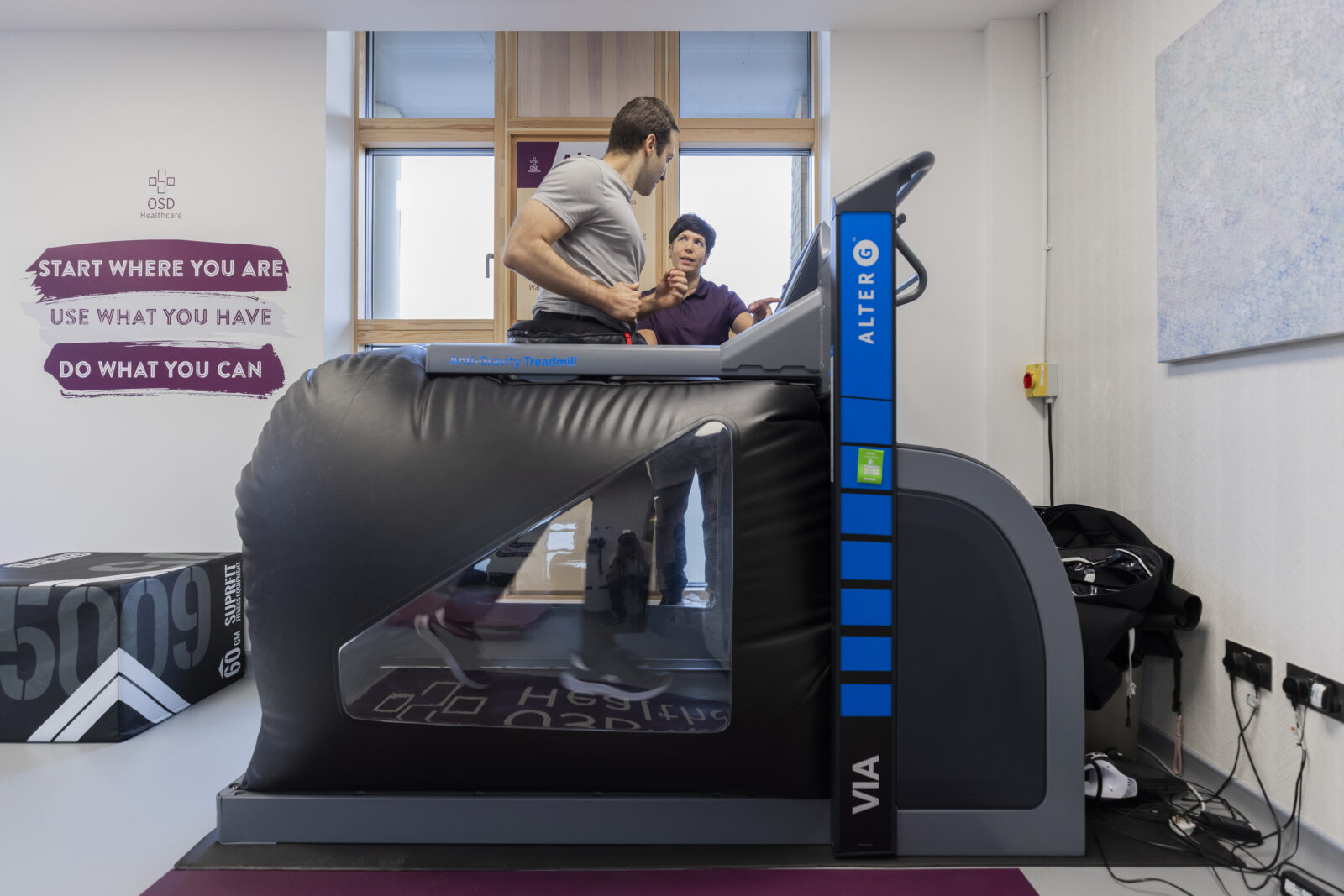
AlterG® Anti-Gravity Treadmill Therapy is a specialised rehabilitation and training treatment that allows you to walk or run while reducing the body weight placed on your joints. The AlterG system uses patented NASA Differential Air Pressure (DAP) technology to gently lift and support your body, helping you move with less pain and strain. This advanced technology enables innovative features that support recovery outcomes and performance.
By placing you in a comfortable, pressurised air chamber around your lower body, the AlterG treadmill can reduce your effective body weight in 1% increments, based on your measured weight, providing finely controlled unweighting. This extends the concept of “weight bearing as tolerated” by allowing clinicians to control loading with exceptional accuracy, with unweighting down to as little as 20% of the patient’s body weight. AlterG’s unique technology enables highly controlled, personalised rehabilitation that supports movement while minimising stress on injured or healing tissues.
AlterG therapy is widely used in orthopaedic rehabilitation, neurological recovery, sports injury treatment, cardiovascular conditioning, and mobility training. It helps restore strength, balance, coordination, and confidence in movement – often much earlier than traditional weight-bearing exercise would allow.
How the AlterG® Treadmill helps recovery
Traditional rehabilitation can be limited by pain, weakness, or fear of re-injury. The AlterG treadmill removes many of these barriers by allowing you to move in a supported environment, offering safer, more effective recovery.
During the session, the treadmill compartment inflates with air to create a reduced-gravity environment.
By reducing gravitational load on your joints and muscles, AlterG therapy can:
- Reduce pain during walking or running, enabling more comfortable movement
- Allow earlier return to movement after injury or surgery
- Protect healing bones, joints, and soft tissues
- Support muscle activation and strength development while avoiding excessive joint loading
- Support the restoration of more normal walking or running patterns by promoting improved gait mechanics
- Improve balance, endurance, and confidence
Because the amount of body-weight support can be adjusted in very small increments, your clinician can safely and gradually progress your rehabilitation as your strength and tolerance improve. The AlterG treadmill helps deliver results in rehabilitation and training by supporting effective, measurable progress for each patient.
What conditions can AlterG® Therapy be used for?
AlterG therapy is suitable for a wide range of conditions where full weight-bearing is difficult, painful, or unsafe. It is commonly used as part of a broader physiotherapy or rehabilitation programme.
Foot & ankle conditions
AlterG can help reduce impact and load while maintaining movement in conditions such as:
- Stress fractures of the foot or ankle
- Plantar fascia injuries
- Ankle ligament reconstruction
- Post-operative foot or ankle surgery
- Chronic foot pain or instability
Knee conditions
It is particularly valuable for knee rehabilitation, including:
- ACL injuries and ACL reconstruction
- Meniscus surgery or meniscectomy
- Knee osteoarthritis (surgical and non-surgical)
- Tibial or femoral fractures
- Total or partial knee replacement
- Patellofemoral pain
Hip & pelvic conditions
AlterG allows safe gait training following:
- Hip arthroscopy or labral repair
- Femoral fractures
- Hip resurfacing or replacement
- Pelvic or acetabular fractures
Spine & back conditions
Reduced-weight walking can help people with:
- Lumbar disc herniation
- Multiple disc injuries
- Back pain limiting normal walking
Neurological & balance conditions
AlterG therapy is often used as part of a structured rehabilitation programme to support mobility and confidence in people recovering from:
- Stroke or transient ischaemic attack (TIA)
- Brain injury
- Neurological conditions affecting balance or coordination
Cardiac health, weight management & mobility support
AlterG can also be beneficial for:
- Cardiac rehabilitation after heart events (with appropriate medical clearance)
- Walking programmes for weight management
- Older adults experiencing functional decline or reduced confidence with walking
Please call to enquire about the price
Ways to payBefore therapy
Before starting AlterG therapy, your physiotherapist or rehabilitation specialist will carry out a thorough assessment. This includes reviewing your diagnosis, symptoms, surgical history (if relevant), movement patterns, balance, and fitness levels.
Together, you’ll agree on treatment goals, such as reducing pain, improving walking confidence, rebuilding strength, or preparing to return to daily activities or sport.
AlterG therapy may be recommended when full weight-bearing is not yet comfortable or safe, but early movement would support recovery. It may not be suitable for all individuals, and your physiotherapist will determine suitability based on your medical history, current condition, and rehabilitation goals.
During therapy
During an AlterG session, you’ll wear specialised shorts that zip into the treadmill chamber, creating a comfortable seal around your lower body. The system is then calibrated to your exact body weight.
Your physiotherapist adjusts the amount of body weight supported, allowing you to walk or run with reduced impact while maintaining a natural gait pattern. Sessions may focus on walking, light jogging, gait retraining, balance, endurance, or sport-specific movement, depending on your needs.
Unlike harness-based systems, AlterG provides smooth, evenly distributed support across the lower body. Many patients report feeling more confident and less fearful of pain or re-injury, which plays an important role in successful rehabilitation.
After therapy
As your recovery progresses, the level of body weight support is gradually reduced. This allows a safe and controlled transition back to full weight-bearing activity, such as walking, running, and everyday functional movement. The AlterG treadmill also enables you to safely increase your training volume during recovery, helping build strength and endurance while minimising the risk of re-injury.
AlterG therapy is often combined with strengthening exercises, balance training, manual therapy, and conventional rehabilitation to support long-term recovery. Once you no longer need reduced body weight support, your physiotherapist will guide you through the next phase of your rehabilitation programme.
Many patients find that AlterG therapy helps them return to activity sooner, maintain fitness during recovery, and regain confidence in their movement.
Appointment and Treatment Plan
Assessment
Your physiotherapist assesses your condition, movement, and goals to decide whether AlterG therapy is appropriate.
Setup
You wear specialised shorts that zip into the treadmill chamber. The system is calibrated to your body weight.
Unweighting
Body-weight support is set in precise increments, reducing load on your joints while allowing natural movement.
Movement
You walk or run at a comfortable level, focusing on gait, balance, endurance, or sport-specific movement.
Progression
As you improve, body-weight support is gradually reduced to prepare you for full weight-bearing activity.
Return to activity
Once ready, you transition back to normal walking, running, and functional exercise as part of your rehabilitation programme.
Experts
We are proud to provide patients with access to a wide range of clinicians, chosen specifically for their knowledge and reputation in their area of expertise. Our experts align with our values: putting you at the centre of your care and educating you on your options at each step of the journey. We encourage you to learn more about our clinicians and how they can help you below. As always, please contact our patient services team if you require any additional information.


We offer 3 ways to pay for your treatment
We exist to take the stress out of private healthcare.
Our payment options are designed to offer you easy access to our treatments and services. You can choose to pay on the day, spread the cost, or use your private medical insurance.
Our patient services team will guide you through the process, providing clear costs and support throughout your course of treatment so you can focus on the thing that matters most – your health.
Whether you pay in advance, spread the cost, or use your private medical insurance, rest assured you will be receiving exceptional care 365 days a year.
Pay in Advance
Even if you do not have medical insurance, you can still get quick and comprehensive access to private medical care.
We provide transparent pricing from your initial consultation to the completion of your treatment so you know where you stand, every step of the way.
We accept all major debit and credit cards, as well as Apple Pay for UK residents. Please note that we do not accept cash or cheques.
Spread the cost monthly
Paying for your treatment at One Stop Healthcare can be spread monthly from 12 to 60 months, rather than paying in one go.
With an upfront 10% deposit paid, via our Financial partner Chrysalis Finance, we offer various flexible terms to enable you to spread the cost, including 12-months at 0% APR. Click here to find out more.
Monthly payments need to be linked to a One Stop Healthcare treatment over £385 and is subject to a 14-day ‘cooling-off’ period before any treatment can start.
Your on-going payments will be made directly between Chrysalis and yourself. It’s that simple.
Pay using PMI
We are recognised by all major health insurance companies and with our extensive range of services, there are lots of benefits to using your insurance with us. Our patient services team is here to answer any questions you may have about using your private health insurance with us.
Please bring along your policy details including your scheme details, membership or policy number, expiry date and confirmation of eligibility to claim (i.e. your authorisation number). If you do not have these details with you, we will require payment from you on the day. Patients are liable for any amounts not settled by their insurer.
FAQs
The AlterG Anti-Gravity Treadmill has been shown to be effective for rehabilitation and training by providing precise, consistent unweighting of the patient’s body weight. By using patented differential air pressure technology developed by NASA, users can reduce the load on their lower limbs in precise percentage increments, down to as low as 20% of their body weight. This controlled reduction in weight-bearing promotes normal gait patterns and helps patients recover with less pain and a lower risk of re-injury.
In addition to rehabilitation, the AlterG Anti-Gravity Treadmill is also used to enhance sports performance for athletes and active individuals, supporting improved conditioning and recovery.
Anti-gravity treadmills like the AlterG use a pressurised air chamber to lift and support the lower body, enabling users to walk or run with reduced mechanical load on their joints. This approach to rehabilitation supports improvements in muscle strength, balance, and coordination and may allow selected patients to begin running sooner than they would on a regular treadmill. The ability to accurately measure patient progress through adjustable weight support, and on selected models, live video monitoring, provides clinicians with valuable feedback to tailor patient care effectively. The AlterG system is specifically designed to deliver results in both rehabilitation and athletic training, supporting faster recovery and improved performance.
Unlike regular treadmills, the AlterG Anti-Gravity Treadmill offers precise unweighting in one-per-cent increments, allowing users to exercise with less pain and strain on injured or weak joints. This makes it especially beneficial for patients recovering from surgery or injury, as well as for neurological patients who need controlled environments to regain mobility. The AlterG system’s ability to promote standard gait patterns and deliver consistent unweighting makes it stand out from traditional treadmills.
The AlterG treadmill can help individuals suffering from back pain by reducing the load on the spine during walking or running. This reduction in mechanical stress allows patients to maintain mobility and build muscle strength without exacerbating their condition. It is often integrated into physiotherapy programmes to support recovery from lumbar disc herniation, multiple disc injuries, and other back-related issues.
While the AlterG is a revolutionary machine, alternatives include other body-weight supported treadmill systems and harness-based devices. These alternatives may not offer the same precise and consistent unweighting or the patented differential air pressure technology that the AlterG provides. When choosing an alternative, it is important to consider the level of support, accuracy, and ability to promote normal gait patterns to ensure effective rehabilitation and training outcomes.