


We’re upgrading our hospital and working to keep disruption to a minimum. Learn more.
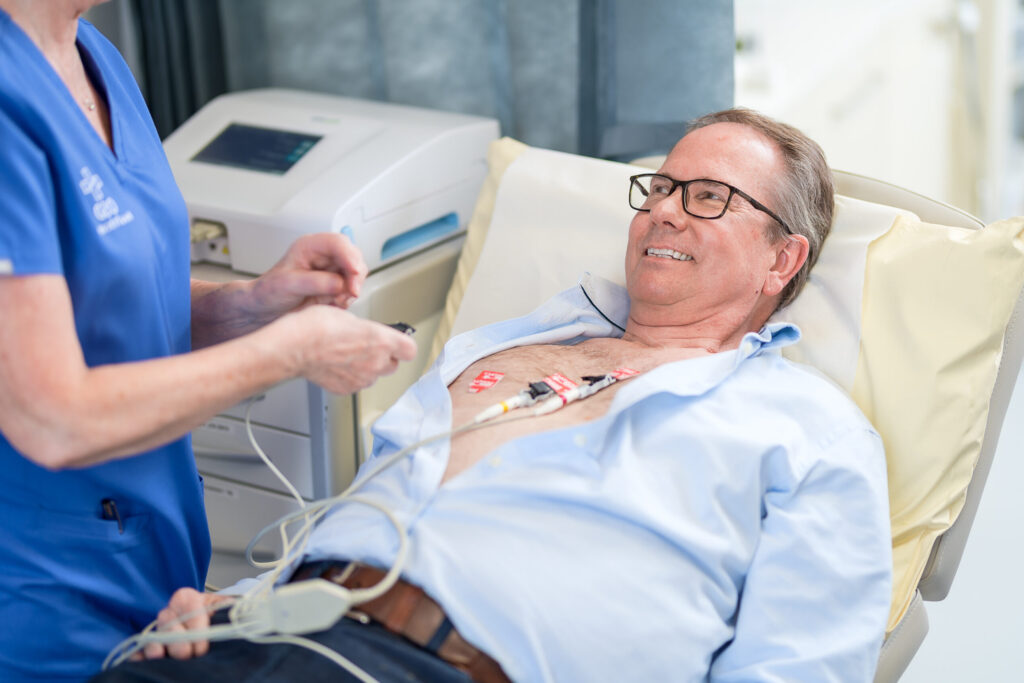
ECG Test
Also known as: heart tracing, EKG, 12-lead ECG, resting ECG, cardiac tracing, electrocardiograph test, heart electrical activity test
An ECG test is one of the most commonly performed cardiac diagnostic procedures, helping healthcare providers assess heart health through monitoring electrical activity.
What is an ECG test?
An electrocardiogram ECG is a diagnostic test that records the electrical activity of your heart through repeated cardiac cycles. The heart’s electrical system controls the timing of heartbeats, coordinating the contraction of the heart muscle to pump blood effectively throughout the body. An ECG machine converts these electrical signals into wave patterns displayed on paper or a computer screen, providing valuable information about heart rhythm and function.
This simple test is entirely painless and non-invasive, typically taking just a few minutes to complete. The procedure involves placing small electrodes on the chest, arms, and legs to detect electrical impulses as they travel through the heart muscle. The ECG records these signals, allowing healthcare providers to assess heart rate, rhythm, and detect potential abnormalities.
ECG testing serves as a widely used first-line diagnostic tool in cardiology. The test provides immediate results and requires no special preparation, making it an accessible option for evaluating various heart conditions and symptoms.
Types of ECG tests
Different types of ECG tests are recommended based on individual symptoms and diagnostic needs. Each type provides specific insights into heart rhythm and electrical activity, helping doctors select the most appropriate test for each patient’s condition.
Resting ECG
A standard ECG performed while the patient lies down comfortably represents the most common form of electrocardiogram testing. This resting ECG takes only a few minutes and is entirely painless, providing baseline information on heart rhythm and electrical activity at rest.
Healthcare providers use this test for initial heart assessments, as it captures a snapshot of standard ECG patterns and can identify apparent abnormalities. The standard ECG uses 10 electrode patches placed on the arms, legs, and chest to provide a comprehensive view of electrical signals throughout the heart.
Exercise ECG (stress test)
An exercise ECG records heart activity during physical exertion, typically performed on a treadmill or exercise bike. This stress test usually lasts about 15 minutes with gradually increasing intensity, allowing healthcare professionals to monitor both ECG patterns and blood pressure as the heart works harder.
Patients walk on a treadmill starting at a slow pace, with speed and incline increasing progressively throughout the test. This approach helps detect problems that may not appear at rest, particularly issues related to blood flow and coronary arteries during physical activity.
During the test, patients should immediately inform the practitioner if they experience chest pain, shortness of breath, or any unusual symptoms. The test continues monitoring as intensity increases until the patient reaches their target heart rate or experiences limiting symptoms.
24-Hour ECG (Holter monitor)
A Holter monitor provides continuous heart monitoring for 24-48 hours or longer, capturing intermittent heart rhythm problems that might be missed during brief standard tests. This portable device is worn on a belt with three chest electrodes, allowing patients to continue their normal activities while it continuously monitors their heart’s electrical activity.
Patients must avoid baths and showers during the monitoring period to protect the electronic equipment. Many cardiologists recommend keeping an activity and symptom diary during monitoring, noting when symptoms occur and what activities trigger them. This ambulatory ECG approach is particularly valuable for detecting sporadic irregular heartbeats throughout daily life.
Monitoring patch
A monitoring patch is a newer form of ambulatory ECG monitoring that consists of a sticky patch placed on the upper left side of the chest. This device continuously records electrical activity and includes a button that patients can press when experiencing symptoms.
The patch can be applied at the hospital or self-fitted at home following instructions from a healthcare provider. After the monitoring period ends, the patch is sent for analysis, providing detailed information about heart rhythm patterns during everyday activities.
Cardiac event recorders
Cardiac event recorders offer portable ECG recording for up to 1 month, capturing heart rhythm when patients press a button during symptoms. These devices are usually held against the chest or worn on the wrist, eliminating the need for chest electrodes, making them convenient for intermittent monitoring.
For more comprehensive monitoring, implantable loop recorders (ILRs) can be placed under the skin of the chest to monitor heart rhythm for up to 3 years continuously. ILR insertion is performed under local anaesthetic as a minor outpatient procedure, providing long-term monitoring for patients with infrequent but concerning symptoms.
What can an ECG test detect?
ECG testing can identify various heart conditions and abnormalities by analysing electrical patterns and timing. The test effectively detects abnormal heart rhythms, including atrial fibrillation (irregular heartbeats) and other arrhythmias that affect heart function.
The test identifies both fast heart rates (tachycardia) and slow heart rates (bradycardia), helping determine whether symptoms relate to heart rate abnormalities. ECG results can reveal signs of a prior heart attack or injury by showing characteristic electrical changes.
Cardiologists use ECG testing to detect electrical changes that may indicate heart strain or prior heart damage. Still, an ECG alone cannot reliably diagnose coronary artery disease or measure blood flow. The test can show electrical patterns that may suggest an enlarged heart or conduction abnormalities, which may then be investigated further with imaging such as an echocardiogram.
ECG monitoring helps healthcare professionals evaluate the effects of certain medicines on heart function and detect electrical conduction abnormalities. However, it’s essential to understand that an ECG shows electrical activity but cannot directly visualise structural heart problems, which may require other tests such as echocardiography.
The test is valuable for detecting certain electrical abnormalities and guiding further cardiac assessment. ECG test results help guide treatment decisions and determine whether additional cardiac testing is necessary.
When is an ECG test recommended?
Healthcare providers recommend ECG testing when patients experience symptoms that could be related to the heart’s electrical activity. Common reasons include chest discomfort, palpitations, or concerns about an irregular heartbeat. Symptoms such as dizziness, fainting episodes, blackouts, or unexplained fatigue may also prompt an ECG to check for rhythm disturbances.
ECG testing is often used for people with high blood pressure or symptoms that may be linked to heart rhythm or strain. It is also routinely included in pre-operative assessments to ensure the heart is functioning safely before planned medical or surgical procedures.
For individuals with cardiovascular risk factors, such as a family history of heart disease, an ECG may be part of a broader heart-health review. The test can also help monitor the effects of heart medications and assess ongoing treatment.
Patients with known heart conditions, including coronary artery disease, may undergo periodic ECGs to track their heart rhythm and overall cardiac function. In these cases, the ECG forms one component of a wider assessment used to guide long-term care.
Please call to enquire about the price
Ways to payBefore the test
Preparing for an ECG test requires minimal effort, but following specific guidelines ensures optimal ECG reading quality. You should wear easily removable upper clothing to facilitate chest electrode placement, as the ECG technician will need access to the chest area to position the electrodes correctly.
Avoid applying creams, lotions, or oils to the chest area before the test, as these products can interfere with electrode adhesion and signal quality. It’s important to inform your doctor about all current medications and supplements, as some substances can affect heart rhythm and electrical activity.
Try to stay relaxed before and during the test, as anxiety can affect heart rate and potentially influence ECG results. No special preparation, dietary restrictions, or fasting is required for standard ECG testing, making it convenient for most patients.
Continue taking your prescribed medications unless your consultant explicitly advises otherwise. Some medicines may need timing adjustments around the test, but most patients can maintain their regular medication schedule.
During the test
The ECG technician will explain the ECG procedure and answer any questions before beginning. This explanation helps ensure you understand what to expect and feel comfortable throughout the testing process.
Ten small, sticky electrodes are carefully placed at specific locations on the arms, legs, and chest. In some cases, these electrode patches may require the removal of chest hair to ensure proper skin contact and signal quality. The positioning follows standardised locations to ensure consistent and accurate recording of electrical signals.
The electrodes are connected to an ECG recording machine via wires, which converts the heart’s electrical signals into readable patterns. Patients lie still and breathe normally during recording, while the ECG recorder captures electrical impulses from the heart.
The machine captures and prints or displays electrical activity patterns in real time, showing characteristic waves that represent the different phases of the heartbeat. The entire recording process typically takes just a few minutes, after which patients can immediately return to normal activities following electrode removal.
Some patients may experience slight discomfort when removing electrodes from chest hair, but the procedure itself is entirely painless. The test involves no radiation exposure and poses minimal risk, with only a slight risk of a rash or skin irritation at electrode sites in sensitive individuals.
After the test
ECG test results are typically available the same day and often reviewed immediately after the recording is complete. A cardiologist analyses the wave patterns, timing intervals, and electrical activity strength to assess heart function and identify any abnormalities.
Normal ECG results are reassuring but may still require additional testing depending on symptoms and clinical presentation. When ECG results show standard patterns, patients can usually resume normal activities immediately without restrictions.
If abnormal findings appear on the ECG, your consultant will explain the results and recommend appropriate treatment or further investigation. Additional tests might include echocardiography, stress testing, or cardiac catheterisation, depending on the specific abnormalities detected.
Follow-up appointments are scheduled based on ECG findings and ongoing symptoms to ensure appropriate monitoring and treatment planning. It’s important to understand that an abnormal ECG doesn’t always indicate serious heart problems, as some variations can be normal for specific individuals.
Cardiologists may recommend lifestyle modifications, medication adjustments, or referral to cardiac specialists based on ECG results and overall clinical assessment. The painless test provides valuable information that guides treatment decisions and helps monitor the progression of heart conditions over time.
Understanding ECG results and next steps
ECG interpretation involves analysing specific wave components, including the P wave, QRS complex, and T wave, which represent different phases of the heart’s electrical activity. Cardiologists examine these components, along with timing intervals and rhythm patterns, to comprehensively assess heart function.
A standard ECG shows regular spacing between wave components and consistent patterns indicating healthy electrical conduction through the heart muscle. When interpreting results, doctors consider the clinical context, including symptoms, medical history, and physical examination findings.
Further investigations following abnormal ECG results might include stress testing, echocardiography, or cardiac catheterisation to provide more detailed information about heart structure and function. Personal devices like smartwatches can record single-lead rhythm tracings, but these are not equivalent to a full medical ECG.
You should discuss ECG results with your cardiologist to understand the implications for your heart health and any necessary follow-up care. Regular monitoring through repeat ECG testing may be recommended for specific conditions or to assess treatment effectiveness over time.
Understanding that ECG testing is just one component of comprehensive cardiac assessment helps you appreciate the value of this simple test while recognising when other tests may be necessary to evaluate your heart condition and guide treatment decisions thoroughly.
Appointment and Treatment Plan
Getting Ready
ECG preparation is simple: wear clothing that’s easy to remove from the upper body, avoid creams or lotions on your chest, and tell your clinician about all medications and supplements you take. No fasting or dietary changes are needed. Stay relaxed, and continue your usual medicines unless your doctor advises otherwise.
Having the Test
Your clinician explains the procedure and answers any questions. Ten small electrodes are placed on your chest, arms, and legs (you may need a small area shaved for good contact). These connect to the ECG machine, which records your heart’s electrical signals while you lie still and breathe normally. The test is painless, takes just a few minutes, and involves no radiation.
After the Test
A cardiologist reviews your ECG results – often the same day. Normal results may require no further action, while abnormal findings may lead to additional tests such as an echocardiogram, stress test, or cardiac catheterisation. Your doctor will explain what the results mean, recommend any next steps, and arrange follow-up if needed.
Experts
We are proud to provide patients with access to a wide range of clinicians, chosen specifically for their knowledge and reputation in their area of expertise. Our experts align with our values: putting you at the centre of your care and educating you on your options at each step of the journey. We encourage you to learn more about our clinicians and how they can help you below. As always, please contact our patient services team if you require any additional information.






We offer 3 ways to pay for your treatment
We exist to take the stress out of private healthcare.
Our payment options are designed to offer you easy access to our treatments and services. You can choose to pay on the day, spread the cost, or use your private medical insurance.
Our patient services team will guide you through the process, providing clear costs and support throughout your course of treatment so you can focus on the thing that matters most – your health.
Whether you pay in advance, spread the cost, or use your private medical insurance, rest assured you will be receiving exceptional care 365 days a year.
Pay in Advance
Even if you do not have medical insurance, you can still get quick and comprehensive access to private medical care.
We provide transparent pricing from your initial consultation to the completion of your treatment so you know where you stand, every step of the way.
We accept all major debit and credit cards, as well as Apple Pay for UK residents. Please note that we do not accept cash or cheques.
Spread the cost monthly
Paying for your treatment at One Stop Healthcare can be spread monthly from 12 to 60 months, rather than paying in one go.
With an upfront 10% deposit paid, via our Financial partner Chrysalis Finance, we offer various flexible terms to enable you to spread the cost, including 12-months at 0% APR. Click here to find out more.
Monthly payments need to be linked to a One Stop Healthcare treatment over £385 and is subject to a 14-day ‘cooling-off’ period before any treatment can start.
Your on-going payments will be made directly between Chrysalis and yourself. It’s that simple.
Pay using PMI
We are recognised by all major health insurance companies and with our extensive range of services, there are lots of benefits to using your insurance with us. Our patient services team is here to answer any questions you may have about using your private health insurance with us.
Please bring along your policy details including your scheme details, membership or policy number, expiry date and confirmation of eligibility to claim (i.e. your authorisation number). If you do not have these details with you, we will require payment from you on the day. Patients are liable for any amounts not settled by their insurer.
Medically reviewed by Dr Georgios Karagiannis - Consultant Cardiologist on 10/01/2026